





I am Govinda Finn. Welcome to “Gateway to Japan.” In this series, we take a deep dive into the important changes shaping the Japanese economy and examine themes that influence the investment decisions of global investors.
Our topic this time is: “Has Japan’s economic regime changed?”
For many years, the Japanese economy has been characterised by the image of low growth, low inflation, and low interest rates. However, in recent years, signs of change have emerged in the environment surrounding prices, wages, corporate behaviour, and monetary policy. Are these changes temporary, or do they indicate a structural transformation of the Japanese economy?
In this article, we examine five assumptions that Japanese equity investors should reassess, while considering the new state and future outlook of the Japanese economy. We also explore key points that global investors should keep in mind when evaluating Japan, incorporating the views of Kei Fujimoto, Senior Economist at Sumitomo Mitsui Trust Asset Management.
Speaker Profiles

Govinda Finn (Interviewer)
Govinda Finn is a Visiting Professor at Tokyo Metropolitan University and serves as an Advisor to Sumitomo Mitsui Trust Asset Management. Previously, he worked at Aberdeen Investments as an Economist covering Japan and developed Asian economies. He is also a member of the International Advisory Board of the Asia Scotland Institute.
He earned a Ph.D. from the Graduate School of Economics at Kobe University and was a recipient of the Japan Science and Technology Agency (JST) “Next-Generation Pioneering Research Program” scholarship. He also holds a master’s degree from the School of Oriental and African Studies (SOAS), University of London, and a bachelor’s degree from the University of Leeds. During his undergraduate studies, he spent one year at the Darla Moore School of Business at the University of South Carolina. He also holds an investment management qualification.

Kei Fujimoto (M.A. Economics)
Senior Economist (Interviewee)
Kei Fujimoto joined Sumitomo Mitsui Trust Asset Management (SuMi TRUST AM) in 2025 as a Senior Economist.
Prior to joining the firm, he worked at the Bank of Japan, where he was engaged in economic research, financial supervision, and international financial regulation. He also gained international practical experience through a secondment to the Monetary Authority of Singapore (MAS).
In terms of academic background, he obtained a bachelor’s degree in economics from Doshisha University and a master’s degree in economics from Osaka University. In addition, he earned a Master of Arts in Economics from Boston University in the United States in 2010.
Volume 2: Summary
For a long time, Japan’s economy has been understood through the framework of low growth, deflation, low interest rates, stagnant wages, and the benefits that a weak yen provides to exporting companies. However, today, rising prices, wage increases, and the normalisation of monetary policy are bringing changes even to the assumptions that investors once took for granted.
The return of rising prices has the potential to profoundly shift expectations for future growth and change the economic regime companies and households operate within. As firms increasingly pass higher costs through to prices, stronger nominal revenue growth can create a virtuous cycle of improved profitability, higher wages, and increased investment.
Rising interest rates should also be viewed as part of the normalisation of the economy. What matters is not just the level of interest rates itself, but whether that level is appropriate in light of developments in the economy, inflation, and financial markets.
Although the structural issue of population decline remains, productivity improvements driven by investments in AI, digital technologies, labour-saving equipment, and similar initiatives are expected to support future economic growth. From a fiscal perspective, a decline in the debt-to-GDP ratio resulting from nominal GDP expansion alone is not sufficient reason for reassurance. Investors should pay more attention to the interaction between fiscal policy, inflation, real growth, and market expectations.
In addition, while a weak yen provides benefits by improving the competitiveness of exporters and boosting the overseas earnings of multinational corporations, it also places a significant burden through higher import prices.
Going forward, companies that can effectively manage higher input costs, enhance productivity, capitalise on opportunities both at home and abroad, and channel rising profits into capital investment and human capital development are likely to command higher valuations. Although Japan’s economy has not completely transitioned into a new era, the time has come to re-examine many of the conventional assumptions that have long prevailed.

1. Is Japan Still Structurally a Low-Growth Economy?
—First, there has long been a view that Japan will continue to experience structurally low growth due to factors such as population decline. Has Japan already emerged from its low-growth era?
I would find it difficult to say that Japan has completely escaped from structural low growth. The biggest reason is population decline. As long as the labour force continues to shrink, it is not easy to significantly raise the growth rate of the economy as a whole.
Since it is difficult to reverse these demographic trends themselves in a short period of time, Japan must improve productivity in order to raise its potential growth rate.
—Where does the key to improving productivity lie?
It lies in corporate capital investment which can help transform the economy into one that can generate high added value even with a smaller workforce. It is important to incorporate AI, digital technologies, labour-saving equipment, and similar innovations. In this regard, the increasing willingness of companies in recent years to invest in labour-saving equipment, including the adoption of AI, is a particularly encouraging development.
—Meanwhile, prices have begun to rise in Japan. How does inflation affect economic growth?
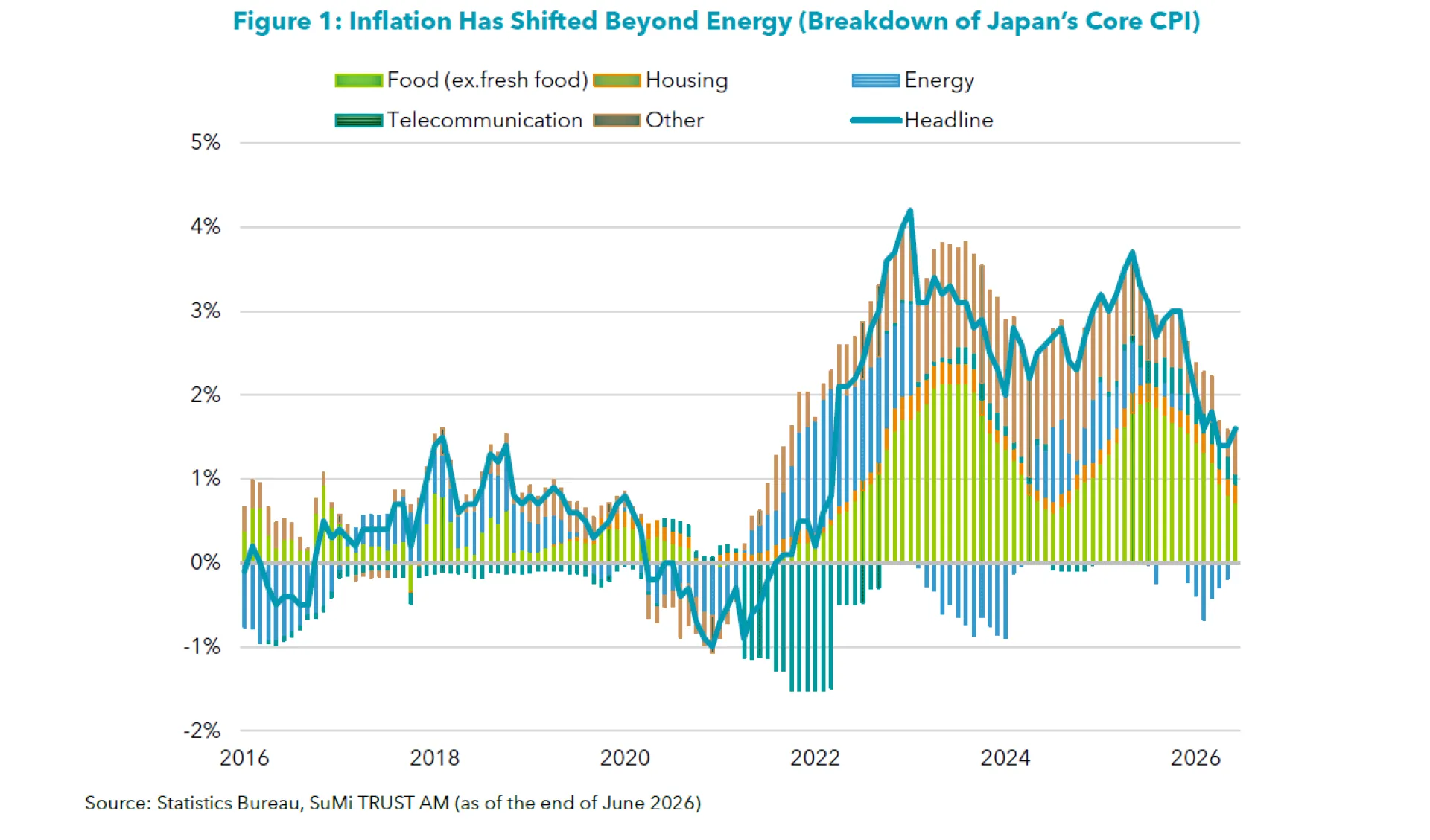
Since around 2021, inflation in Japan has risen significantly. The initial drivers were largely external cost shocks, including the sharp recovery in global demand following the COVID-19 pandemic, higher commodity and energy prices, Russia's invasion of Ukraine, and the subsequent depreciation of the Japanese yen.
At first, the rise in inflation increased nominal growth primarily through higher prices, without a commensurate increase in real output. However, the persistence of inflationary shocks has meant that businesses and investors have belatedly started to adjust expectations for higher nominal growth. This shift is significant because expectations about nominal growth influence a broad range of corporate decisions, including pricing strategies, investment plans, wage policies, and capital allocation.
From a longer-term perspective, an even more fundamental change may be underway, with a shift in inflation expectations being reinforced by rising wages and potentially reshaping Japan’s economic environment (see Figure 1).
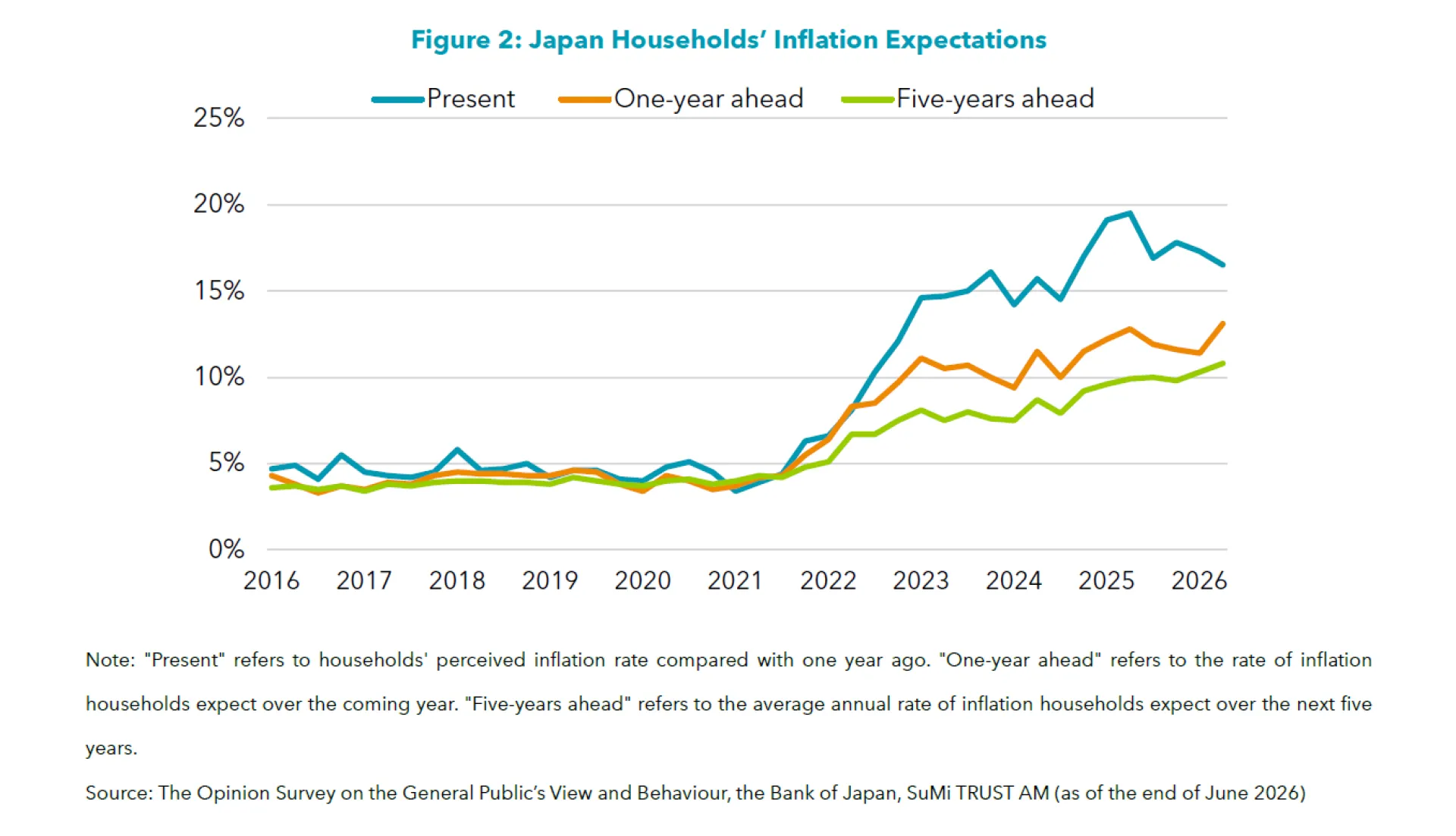
The establishment of higher inflation expectations carries significant importance in Japan. During the long period of low inflation and occasional deflation, households had relatively little incentive to bring forward purchases, contributing to a greater preference for saving. If households become more confident that prices and wages will continue to rise, the incentive to defer consumption may diminish, providing greater support for domestic demand.
A similar shift may also occur among firms. An inflationary regime, combined with stronger nominal demand, can improve the expected returns on investment and reduce the incentive to postpone capital expenditure. As companies become more willing and able to pass higher costs on to customers, stronger nominal revenue growth can support capital expenditure, business expansion, and wage increases. Together, these developments could reinforce domestic demand and create a more durable cycle of nominal growth, inflation and income gains.

—So, while Japan still faces the structural challenge of low growth, are you saying that the way the economy functions is beginning to change?
Exactly. Even if structural factors such as demographics constrain real GDP potential, higher inflation expectations can alter household and corporate behaviour, encouraging consumption, investment, and greater economic dynamism. If such a cycle becomes firmly established, it will also contribute positively to Japan's real economic growth.
Japan has not become a high-growth country. However, I believe that the longstanding assumption underlying the Japanese economy—that "prices, sales revenues, and wages do not rise"—needs to be reconsidered.
2. Are Interest Rate Hikes a Cause for Concern?
—The Bank of Japan has been raising its policy interest rate. In the past, there were concerns that interest rate hikes would cool the economy and push Japan back into deflation. Are the current rate hikes also negative for the Japanese economy?
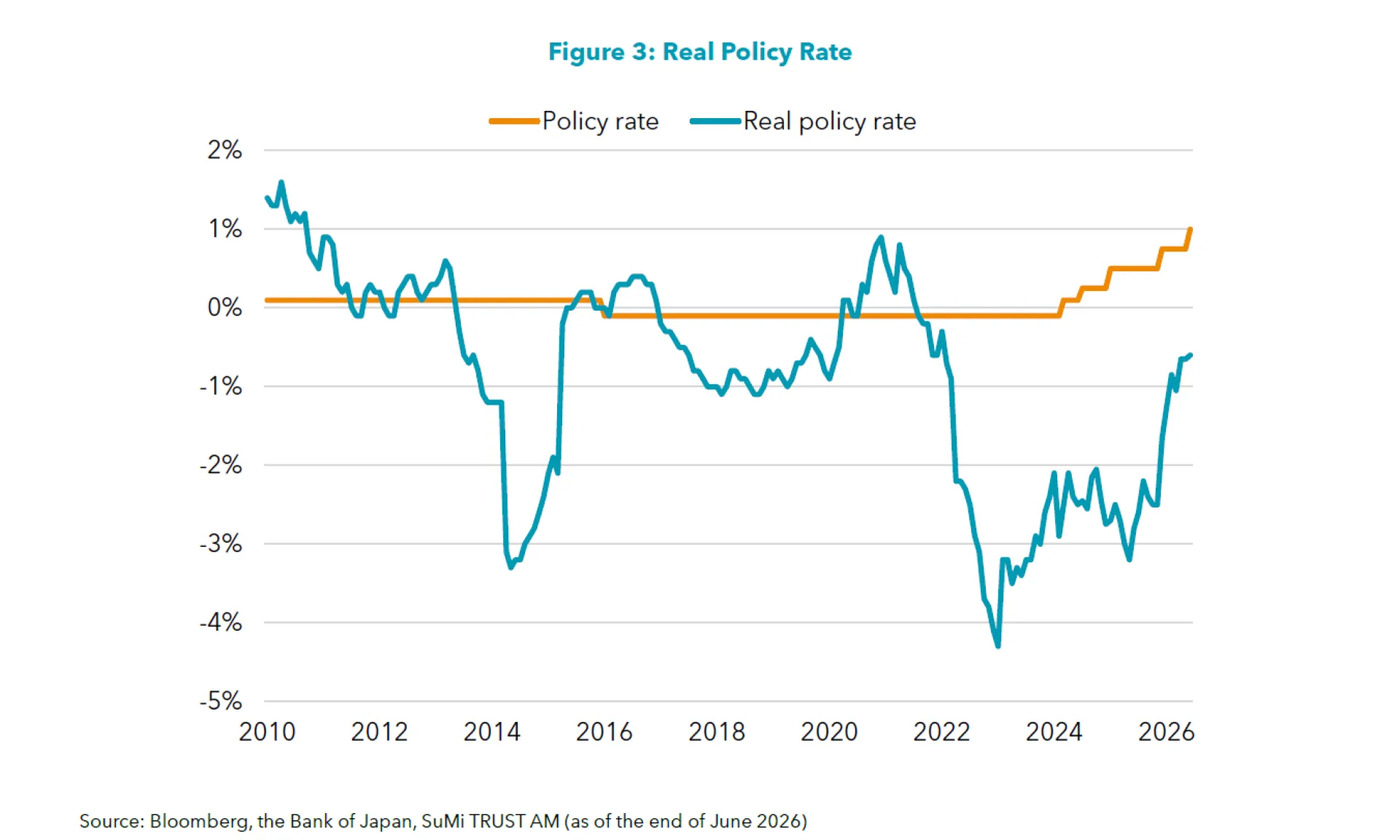
I believe that the current financial environment remains accommodative, even though policy interest rates have risen. What is important is not only the nominal policy rate itself, but also the real interest rate—that is, the interest rate after adjusting for inflation.
Adjusting for inflation, the real policy rate in Japan remains negative, implying that current interest rate levels are not yet at a level that strongly restrains economic activity.
—Current inflation includes supply-side factors such as rising import prices and higher resource costs. Is it appropriate to raise policy rates in response to that kind of inflation?
It is true that current price increases are driven not only by demand, but also to a significant extent by supply-side shocks.
Determining how aggressively interest rates should be raised in response to inflation caused by supply constraints is a difficult issue. Nevertheless, economic activity at present is solid. Looking at indicators such as business sentiment, demand has not collapsed.
As long as the economy remains solid, I believe there is room to gradually move monetary policy from an extremely accommodative stance toward a more normal one.
—How should investors view rising policy rates?
Real policy rates remain negative and financial conditions continue to be accommodative. Against this backdrop, the economy has remained on a solid footing. At the same time, heightened geopolitical tensions in the Middle East have increased the risk that rising import prices could feed through into domestic inflation. Taking these factors into account, the Bank of Japan's current normalisation of monetary policy appears consistent with economic and price developments. Investors should therefore have little reason to fear that higher interest rates will trigger a sharp downturn in economic activity.
3. Will Japan's Debt Ultimately Lead to a Crisis?
—Japan has one of the highest government debt-to-GDP ratios in the world. However, the debt ratio has begun to decline due to growth in nominal GDP. Can we therefore conclude that Japan's fiscal risks are becoming smaller?
I do not think we should become complacent simply because the debt ratio is declining.
Certainly, when nominal GDP increases, the debt-to-GDP ratio falls mechanically (see Figure 4).
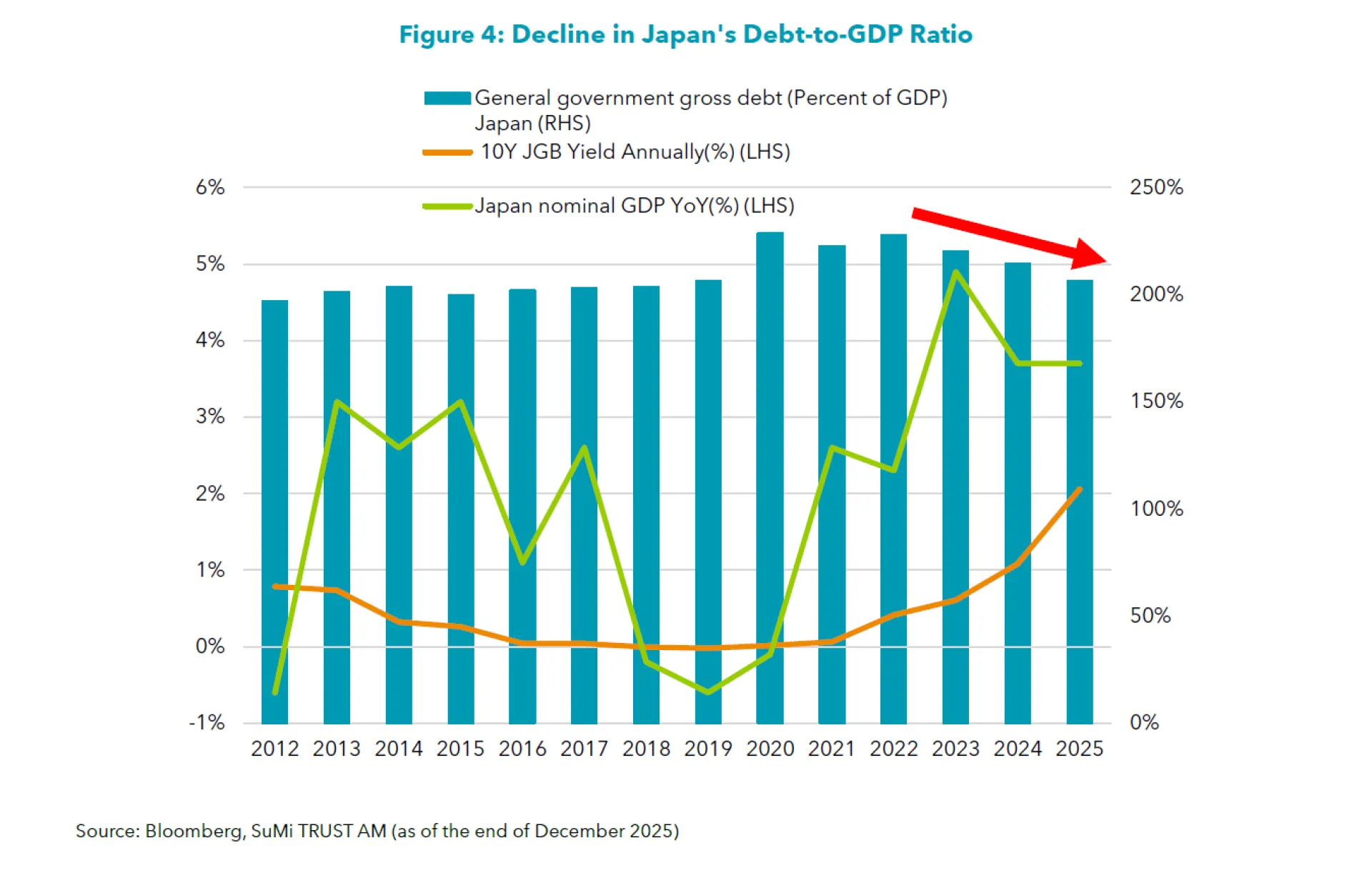
However, current nominal GDP growth reflects not only real economic growth but also the effects of inflation driven by factors such as rising import prices.
Because part of the increase in nominal GDP has been driven by import price-led inflation, the substantial decline in the debt ratio cannot necessarily be regarded as a desirable development that reflects the underlying strength of the Japanese economy.
—There are also calls for fiscal measures such as economic stimulus and tax cuts. What is your view of such policies?
Short-term economic measures can certainly have some positive effects.
However, if tax cuts or cash handouts are repeatedly implemented without clearly identifying funding sources, there is a risk of undermining fiscal sustainability over the medium to long term.
In particular, the consumption tax is an important source of funding for Japan's social security system. Policymakers need to consider not only the short-term effect of supporting economic activity, but also the implications for future social security and fiscal management.
On the other hand, policies that promote capital investment and productivity-enhancing technological development can help strengthen long-term growth potential.
What is important is not merely the size of fiscal spending, but whether that spending constitutes an investment that contributes to future growth, or simply a temporary distribution of resources.
—Do rising long-term interest rates affect the government's interest payment burden?
Yes, they do.
However, not all government bonds are immediately replaced by debt issued at current market interest rates. Since Japanese government bonds generally have relatively long average maturities, it takes time before rising interest rates are fully reflected in the government's interest expenses.
Nevertheless, as government bonds mature and are refinanced, higher interest rates will gradually be incorporated into fiscal costs.
Therefore, if long-term interest rates continue to rise, the government's future interest payment burden will certainly increase.
—Does that mean rising long-term interest rates are always a bad sign?
Not necessarily. While the recent increase in long-term interest rates has partly reflected a rise in risk premiums associated with the government's expansionary fiscal policy, it is not solely a fiscal story. It may also reflect firmer inflation expectations and improved expectations for future economic growth. Put differently, higher long-term rates are also a sign that Japan is emerging from deflation and that more positive forces are beginning to take hold in the economy.
4. Are Rising Labour Costs Negative for Companies?
—For many years, Japanese companies have secured profits by keeping labour costs under control. If wage increases continue, won't corporate profits come under pressure?
One of the biggest changes in Japan in recent years has been the shift in wage setting behaviour, with the annual Shunto wage negotiations resulting in significantly higher wage outcomes (see Figure 5). As long as wage growth is in line with growth in corporate profits, wage increases are not necessarily burdensome for companies. In fact, I view the current trend of wage increases as a positive development for the economy as a whole.
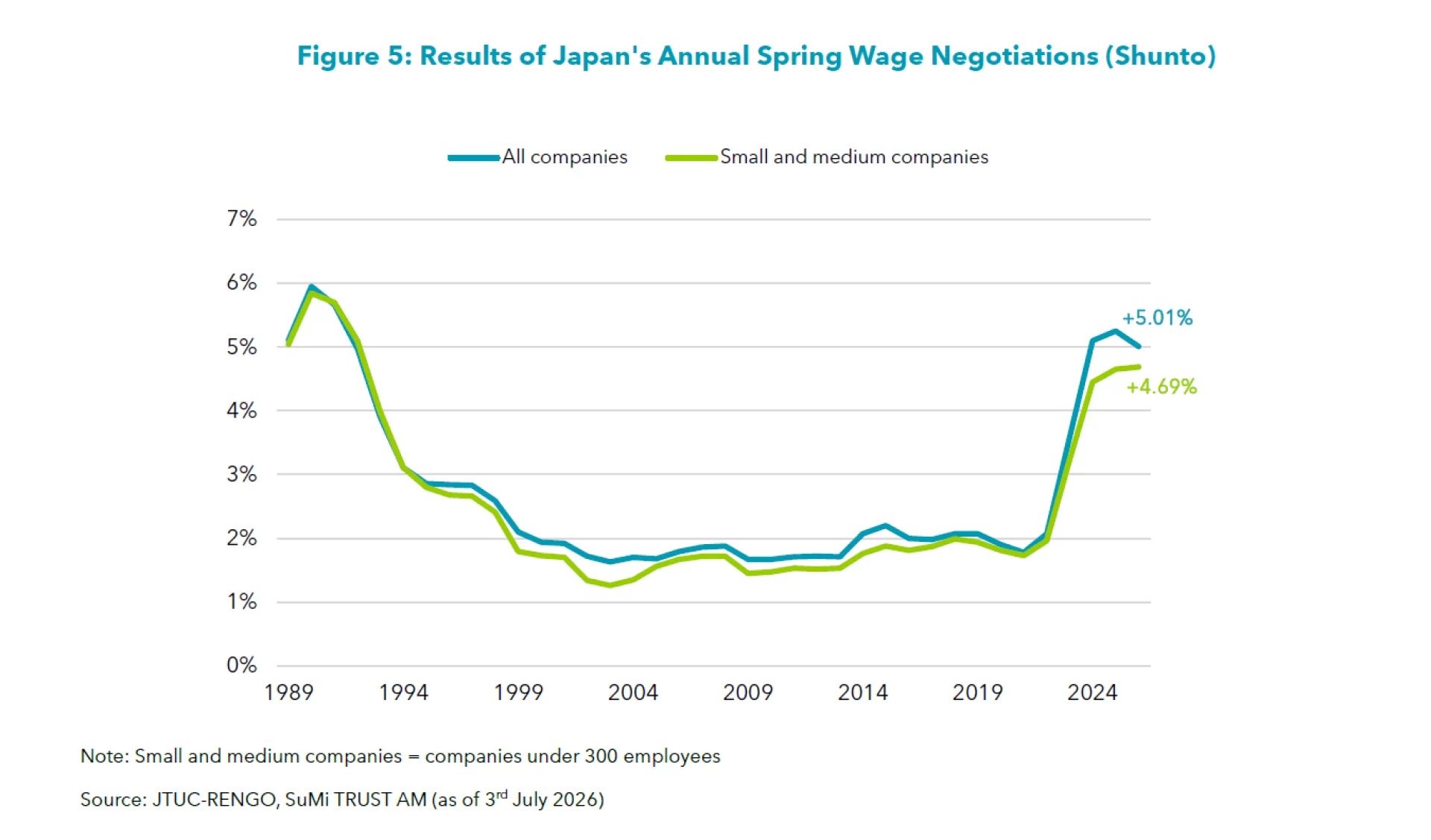
Ongoing wage growth reflects expectations of continued expansion in sales revenues and cash flows, together with labour shortages. As companies gain the ability to pass higher costs through to prices and generate stronger nominal revenue growth, part of those gains can flow back to employees in the form of higher wages.
—So you are saying that wage increases and corporate profitability can coexist?
Yes, I am. As wages rise, households gain greater spending power. When consumption increases, corporate sales revenues grow, which in turn supports further wage increases.
Wage growth should not be viewed simply as a cost increase. Rather, it should be understood as part of a broader cycle: price pass-through → higher sales revenue → wage increases → stronger consumption → further increases in sales revenue.
—Can all companies raise wages in the same way?
This is where differences between companies become important.
For example, corporations with overseas operations, strong pricing power, and high profitability are generally better positioned to absorb the burden of wage increases.
By contrast, domestic companies, particularly small and medium-sized enterprises (SMEs), may find it difficult to pass higher costs on to customers. As a result, they may have to absorb rising raw-material and labour costs themselves, putting pressure on profitability.
Investors therefore need to look beyond wage growth alone. They should assess whether companies are able to pass higher costs on to customers, and whether sales revenue growth and productivity gains are outpacing increases in labour costs.
5. Is a Weak Yen Automatically Positive for Japan?
—Traditionally, a weaker yen was thought to improve the competitiveness of exporting companies and benefit the Japanese economy. Is that view still correct today?
A weaker yen still has both positive and negative effects.
On the positive side, it improves the price competitiveness of exports. In addition, when profits earned overseas are converted back into yen, their value increases, boosting the earnings of global companies.
For investors, this provides a clear benefit in the form of expanding profits for companies with substantial overseas revenues.
—On the other hand, has the benefit of a weaker yen become smaller than it used to be?
That is certainly possible.
In the past, many Japanese companies manufactured products domestically and then exported them overseas, so a weaker yen tended to enhance export competitiveness directly.
Today, however, the relationship between exchange rate movements and trade volumes is weaker than once it was, as firms have increasingly globalised their supply chains (see Figure 6). Furthermore, a growing share of profits generated overseas is retained or reinvested abroad.
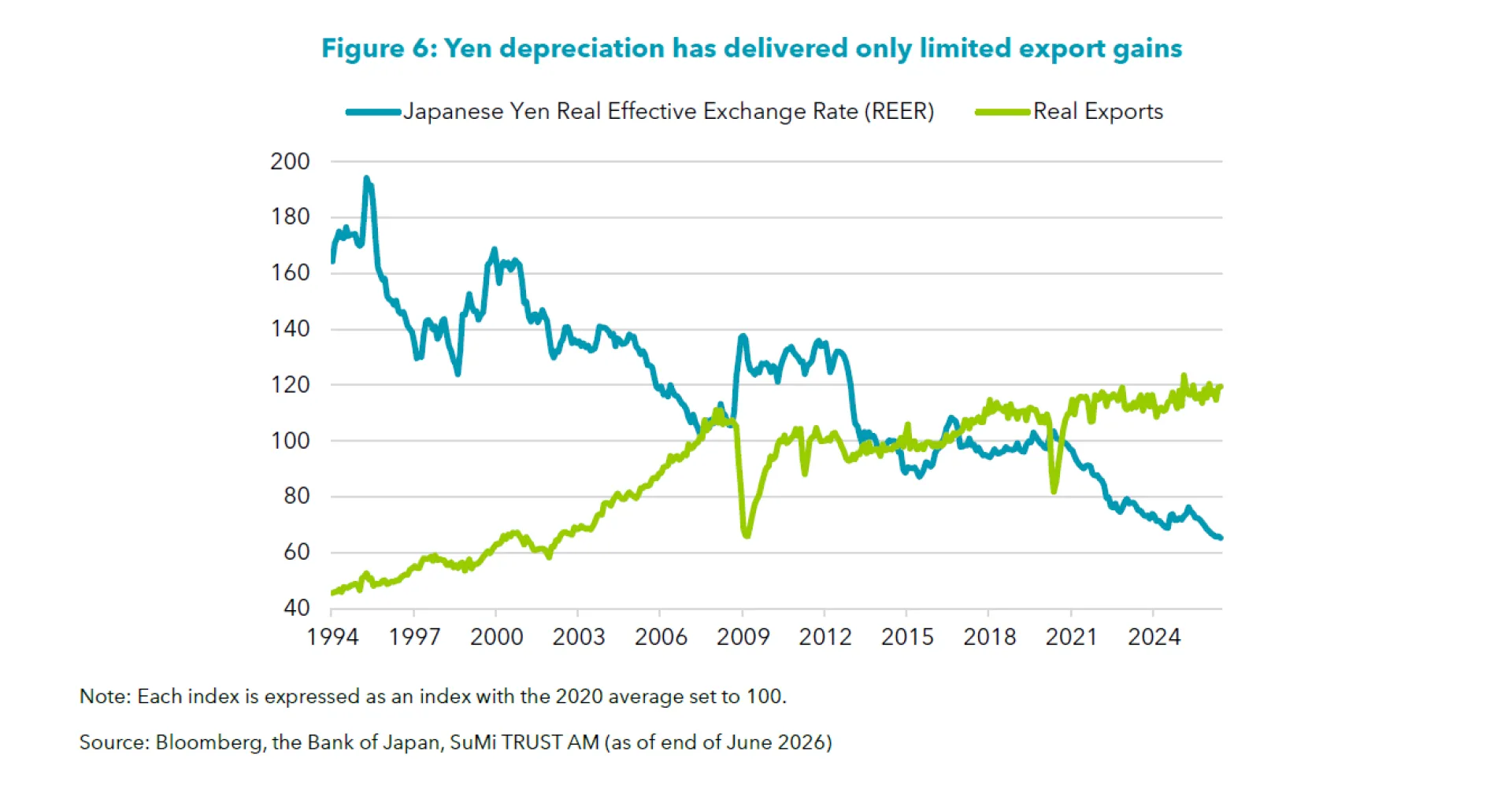
As a result, even when a weaker yen boosts the yen value of overseas earnings, those gains do not necessarily return to Japan to be used for domestic investment or consumption.
It is therefore important to distinguish between the benefit that a weaker yen provides to corporate earnings and its broader impact on the Japanese economy.
—What are the negative aspects of a weaker yen?
The main downside of the weaker yen is higher import prices.
Japan relies heavily on imports for a wide range of items, including energy, raw materials, and food. As the yen depreciates, the cost of those imports rises, putting pressure on households' real incomes.
In addition, structural factors have increased overseas payments and investment flows. These include growing payments for overseas digital services and investments in foreign assets by Japanese households and investors.
As a result, it is no longer sufficient to assume that a weaker yen will automatically lead to stronger exports and greater prosperity for Japan as a whole. The overall economic impact has become more complex than in the past.
—What are the primary causes of the current weakness of the yen?
In the short term, major factors include interest-rate differentials with overseas economies, developments in the trade balance, and market perceptions of fiscal sustainability.
Even if the Bank of Japan raises interest rates, interest-rate differentials will not narrow significantly if overseas interest rates also remain high.
Rising oil prices can also weigh on the yen by increasing import costs and reinforcing expectations of a deterioration in Japan's trade balance.
Furthermore, market participants are also paying increasing attention to the potential implications of Japan's fiscal position for the yen.
Over the longer term, the fundamental strength of the Japanese economy, including demographic trends and potential growth rates, also affects the value of the currency.
If expectations for economic growth are weak, demand for a country's assets—and, by extension, its currency—may also decline.
—For overseas investors, does the historically weak yen represent an investment opportunity in Japan?
All in all, yes, I think so. From the perspective of investors who hold foreign currencies such as U.S. dollars, Japanese assets may appear relatively inexpensive. But rather than simply using the weak yen itself as the reason for investing, I would like investors to pay attention to companies that are successfully turning changes in the economic environment into opportunities for sustainable growth.
Japan has companies that earn substantial revenues in overseas markets, companies that can capture demand related to AI and digitalisation, and companies with advanced technological capabilities. Also, despite the headwinds from rising import prices, some companies have successfully managed higher input costs, reflecting changes in corporate pricing behaviour and the broader acceptance of price increases.

—Finally, what do these changes in the five assumptions mean for investors?
Japan's structural economic challenges have not all been resolved. Issues such as population decline, a low potential growth rate, government debt, and high sensitivity to exchange-rate fluctuations remain.
At the same time, however, the environment surrounding prices, wages, corporate pricing behaviour, capital investment, and monetary policy is clearly different from what it was during the deflationary era.
In the past, companies in Japan could broadly benefit from low interest rates and a weak yen. Going forward, however, the gap is likely to widen between companies that can adapt to rising wages, higher raw-material costs, and higher interest rates and those that cannot.
Companies that can effectively manage higher input costs, enhance productivity, capitalise on opportunities both at home and abroad, and channel rising profits into capital investment and human capital development are likely to command higher valuations.
It is still too early to draw a final conclusion as to whether Japan's economy has completely transitioned into a new era. However, at the very least, the following traditional assumptions can no longer be accepted at face value:
• “Japan will not change because it is a low-growth economy.”
• “All interest-rate increases are bad.”
• “Investors should be concerned about the size of Japan’s debt.”
• “Wage increases damage corporate profits.”
• “A weaker yen automatically benefits the Japanese economy.”